ConectUS Wireless

ConectUS Wireless

The Mindset Shift That Changes Everything in Sales

Selling Success is not only determined by your knowledge of the sales cycle, selling strategies, sales secrets, or even conversational skills. As important as these things are, your personal emotions will often determine your level of attainment and financial success in your selling career and in other areas of your life. Regrettably, many sales training books and courses ignore this area completely. Have Faith. We are not referring to what some would call religious faith, but we’re not discounting that either. What we’re referring to is altering a basic thought pattern that many are saddled with in their minds and, consequently, in their careers and lives. We are suggesting that we work to eliminate these three career-limiting concepts from our mental vocabularies. The super successful people in all walks of life have done so already. You can too. The three concepts are Try, Hope, Believe. Why in the world would we suggest that these words that sound so nice are actually career and life limiters? We will look at each word in a little more depth to find the answer. Try is defined as to attempt to do. A thesaurus gives synonyms such as endeavor, struggle, strive, seek, and make an effort. All are very positive and noble, I suppose. These words share two things in common. They suggest action, which is a good thing, and the possibility of failure, which is definitely not a good thing. Therefore, do not embrace the word try. It is not a confidence-building word. Hope is defined as to feel that something desired may happen. Again, the thesaurus provides synonyms such as anticipate, wish, look forward to, and dream, which are all feel-good sounding words, but once again, there is a sense of doubt attached. I might just add that the opposite of hope is despair. Hope may be actually weaker in nature than the word try because it does not even involve action, while it definitely allows for the possibility of failure. Is it a confidence builder? I don’t think so. Belief is defined as having confidence in the truth, the existence, or the reliability of something, People have the tendency to believe in what others have told them. A belief is quite like superstition, which is defined as an irrational, but usually deep-seated belief in the effects of a specific action or ritual, especially in the likelihood that good or bad luck or result will occur from performing it. Believing in success is much more beneficial than not believing; however, it still has a hint of irrationality to it. That brings us back to the concept of having faith. Faith is much stronger than belief. Faith is total, unfaltering trust. Faith is having a complete and confident expectation in the outcome. Faith is the complete removal of doubt from one’s mind. You might ask, “How do you obtain faith without first obtaining absolute proof?” You do it simply through preparation. You develop self-confidence by knowing that you are prepared for success. You have done all you can up to this point. Then you realize that preparedness never ends and success is ongoing. There is no failure. There are only learning opportunities and life-path alterations. This type of faith is what is at the heart of all great success stories. How is your strength of faith in relation to your level of preparedness? If you are prepared, you can be confident and expect success!

ConectUS Wireless, Wireless

Juggling 9 or Dropping 10

Juggling 9 or Dropping 10 In business, there is a fine line between productivity and overload. Many leaders pride themselves on managing multiple projects at once, believing that more activity equals more progress. However, there is an important lesson hidden in the phrase, “Juggling 9 or Dropping 10.” Imagine a skilled juggler comfortably keeping nine balls in the air. The performance is smooth, controlled, and impressive. Then someone hands them a tenth ball. Instead of improving the act, the additional ball may cause the entire routine to collapse. Suddenly, balls begin dropping, focus is lost, and what was once successful becomes chaotic. The same principle applies in business. Every project requires time, attention, resources, and decision-making. While organizations often seek growth through new opportunities, there comes a point where taking on more work does not create more value. Instead, it spreads teams too thin, creates bottlenecks, increases errors, and delays completion. The result is often ten partially completed projects instead of nine successful ones. Effective leaders understand that capacity management is just as important as ambition. They regularly evaluate workloads, available resources, and strategic priorities. Rather than asking, “What else can we add?” they ask, “What can we successfully complete?” This mindset requires discipline. Opportunities will always exist. New clients, initiatives, and ideas can be exciting, but every commitment carries a cost. Adding one more project may mean reducing the quality, speed, or focus of existing work. The strongest organizations recognize that saying “no” to one opportunity often allows them to say “yes” to excellence elsewhere. The goal is not to operate below capacity. Businesses should challenge themselves and maintain enough activity to drive growth and innovation. However, sustainable success comes from finding the right balance—enough projects to maximize productivity, but not so many that performance suffers. A healthy organization knows its limits and respects them. It monitors workloads, communicates resource constraints, and prioritizes execution over excessive expansion. Teams that can consistently deliver on nine important projects will outperform teams that continually struggle with ten. Success is not measured by how many balls are in the air. It is measured by how many remain there. In business, knowing the difference between juggling nine and dropping ten can be the difference between growth and frustration, excellence and mediocrity, or success and failure.

ConectUS Wireless, Verizon

7 Truths Every Sales Professional Must Know

Many people, including some in the sales profession, believe that sales training is a waste of time and money. A popular belief is that salespeople are born to sell, and that an individual either “has it” or they don’t, and nothing can be done to change it. This belief has been proven to be wrong. Selling is a learned skill. Many of the beliefs about the skills required for success are much different from those actually necessary. Below is a list of truths about the sales profession: 1 – Sales is a learned skill. A sales rep will never reach their true potential until this fact is accepted. True professionals study and practice the skills proven to be effective and continue sales training throughout their careers. 2 – Sales calls can be made at any time. Many sales reps actually believe sales calls can only be made after 9:00 or before 3:00. The professional knows someone prefers 7:00 a.m., and others work evenings. Professionals find people to see them for a full day every day. 3 – The mind controls most sales. This is why many sales come in succession. It’s often called a lucky streak, but it isn’t. It is the sales rep “assuming the sale” without faking it. The previous sale programs the brain to believe the next one will buy also, and it often happens as a result. It is a 100% true belief that the buyer is going to buy today. 4 – Good telemarketing is critical. Work backwards and determine how many calls are necessary to develop a full week of appointments. This number is the number of calls that must be made each week. 5 – Increase selling time. The only time that is real “value added” is the time spent with the prospect or customer. The time getting an appointment, traveling to and from locations, completing paperwork, and attending meetings is an incidental necessity, but not value-added. Do all of these tasks outside of the high-value-added hours. Increasing value-added selling time can be learned using lean manufacturing and Six Sigma principles. 6 – Learn to Close. Closing is the most learned skill in the profession. When a prospect objects to the price, color, service, or anything else, the sales pro knows exactly how to respond down to the specific words. At the point of the objection, there is no time to think. All thought should be directed toward body language and preparing the next 3-4 steps in the sales cycle. 7 – Learn sales techniques. Techniques are not tricks, and no sales rep would be effective trying to trick someone into buying. Some believe closing is using tricks but it is not true. It is simply being an effective negotiator, helping the customer make a buying decision. For example, with a service objection such as the length of after-sales service being too short, the sales rep should use a “right-angle close”. This negotiation is simply stating the answer with a buying question, such as “If I can get the two-week service changed to four, will you give us a try today”?

ConectUS Wireless

Avoid These Mistakes to Win Your Next Sale

Getting a sale is not an easy task and most people who have some amount of experience with sales are quite aware of that. When a salesperson prepares his or her pitch, there are so many factors to be taken into consideration including what should be avoided so as to not turn the potential client off. There is, of course, no way of reading your client’s mind, but there are certain things that you can be pretty sure no one would like, especially those who might be spending money on your product. Perhaps the main thing when it comes to sales is the point that closing the sale is not only about the product you are selling. A large part of the client’s decision to accept or reject the product can depend on how you conduct yourself. If you are amicable, confident and knowledgeable they could warm to you and your product but if they do not like you as a person, their reaction to you could extend to what they feel about the product. For example, being late for an appointment (especially when you trying to sell something to a client) is an absolute faux pas. But you would be surprised at how many people go late to sales appointment, whatever the reason for that might be. As a salesperson, if you assume that you can get away with such misdemeanors, you are being extremely naïve. For starters, be aware of the fact that most people are quick with first impressions and these impressions usually last. Once they have already had a negative impression about you for making them wait, they might not be too open about listening to what you have to say about the product you have on offer. From your point of view, they might just have been waiting five minutes or 10, but keep in mind that almost everyone is running on a tight schedule and, after all, time is money. To close a sale, a salesperson has to be confident about him/herself and also the product they are offering. Part of your job as a salesperson is to convey to the client that your product is the solution to a certain problem that they have. But there is a very thin line between confidence and overconfidence. If you walk into a sales meeting acting and talking overly self-confidently it could very well be a turn off. Your clients do not want to be treated as simpletons who do not know what is good for their business. You want to identify a need for them in their business setup and offer them a solution, and not talk to them as if they are too slow to know any better. You want to make sure than when you are presenting your pitch you do not come across as being arrogant. Clients especially dislike having to speak with salespeople who treat them with disdain and superiority. If that is the case, even if the client needs the product you are offering, it is very possible that they might choose to get a similar product from somewhere else. The same goes for aggressiveness. There are many salespeople who believe that pushing the product forcefully can lead to a sale but that is a delicate path to tread. This might work once in a while for you, but more often than not, clients get uncomfortable when you assertively try to push a product onto them. Clients like to make their own decision and you are there to offer them options, not to force decisions on to them. Bear in mind that your clients are usually well aware of the workings of their business and industry norms, and being as knowledgeable as they are they will probably not digest everything you say without questions. Part of the problem lies in the fact that many salespeople do not get proper training into the do’s and don’ts of a sales pitch so they might go about doing things in anyway as long as they can close the deal. A salesperson that is not properly trained in sales might not realize the importance of customizing the sales pitch for different clients, body language or the various other matters that impact sales. Carrying out a good sales pitch and closing the deal is nothing short of an art and it is most definitely not something everyone can handle naturally. If you are a manager, make sure the salespeople you are sending out into the field are those who understand the nature of sales and clients and deal with them accordingly. Knowing the ways of keeping your sales pitch under control is one of the first steps to closing a sale.

ConectUS Wireless

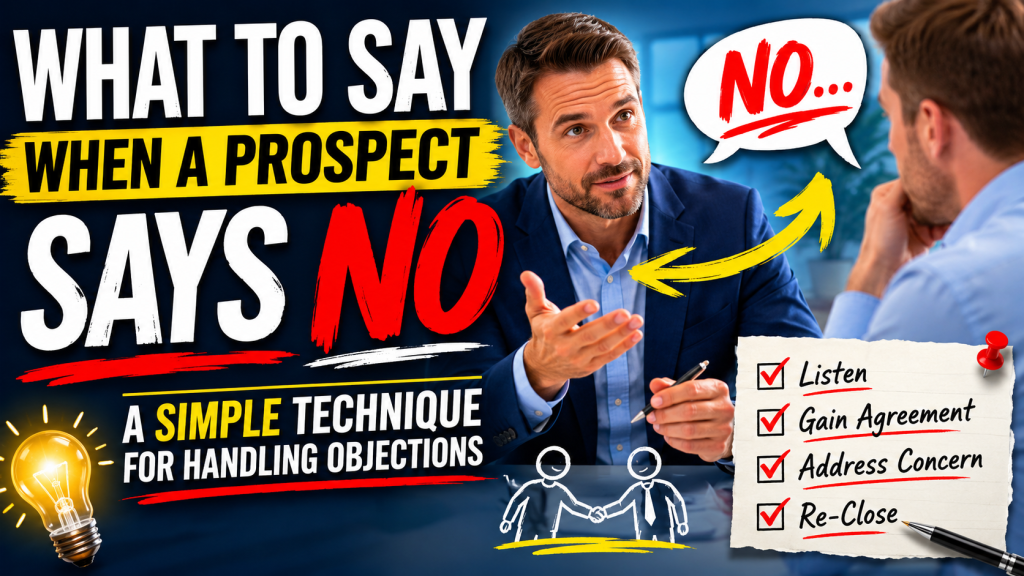
What to Say When a Prospect Says No: A Simple Technique for Handling Objections

You’ve just finished giving your presentation to your prospect, and you shown him all the benefits and reasons why he should take action, now, and purchase your product. Everything was presented in a very logical manner, and he was supposed to say, “Yes.” But he didn’t. You’ve just been told no, and given some objection or reason why your prospect doesn’t want to make a purchase or make a decision, now. For a moment, all that head of steam that you were so neatly and professionally building up, has just collapsed like a withering balloon. You’re facing your prospect, trying to figure out what went wrong and how to salvage the sale. How can you convince this person that they are wrong by not choosing to buy from you, right now? Every sales person has been in this exact same boat, more times than we will ever want to admit to or remember. However, it is very important to remember that being told no, right after making your close and asking for the sale, is a fairly common experience. It does NOT, however, mean that your sale is now doomed. It does NOT mean that your prospect has automatically shut you off. And…most importantly, it is vital to remember that your prospect is saying no to the product/proposal you are offering, and NOT saying no to YOU. There many ways to overcome and handle objections. This is not the purpose of this article. Instead, what I am going to give you is an important tip on how to TRANSITION from hearing an objection, to proceeding to handle it. This technique works on any kind of objection that you will come across, and it’s very easy to master. First of all, always keep in mind that if you try to tackle your customer’s objection, head on, as an objection, then you are setting the stage for an adversarial situation, and in that scenario, you will never win. Your goal is not to make your prospect wrong, but rather to let your prospect be RIGHT. When your customer voices an objection, do NOT immediately respond to it. Jumping right in and attacking the objection only makes your customer more defensive and also makes them believe you really didn’t hear nor understand what they were saying. Instead, count to 5, in your head. As you are counting. slowly nod your head so your customer sees that you are truly listening and comprehending what they are saying. Doing this will work wonders in bringing you and your prospect closer together. Repeat the objection back to your customer, but repeat it in the form of a QUESTION. “Well, Fred, I definitely can understand what you’re saying, and it’s a very good point. In fact, many of my clients also felt the same way, when they were considering this deal. Am I correct in believing that you do feel that this makes sense, but you’re concerned about…..(state the objection, here)?” When your prospect then AGREES with you on this question. Simply ask them if this is their only concern. (never use the word “objection” to your customer) Your next move is to say the following: “So, Fred, would it be reasonable to say that if we could find a way to effectively address this issue, to your satisfaction, then there really would be no reason to not move ahead with this?” Once you get that second agreement/commitment. Proceed with addressing your customer’s concern, and then re-close. You will find, that if you remember to use these simple steps, your closing percentage will greatly increase. See you at the top!

ConectUS Wireless, Digital Agent Program
ConectUS Wireless, Verizon, Wireless

Verizon’s Digital Agent Program is Perfect for Commercial Realtors

ConectUS Wireless has achieved substantial success within our partner community through Verizon’s Digital Agent Program. Commercial real estate professionals now have a unique opportunity to leverage this same program to deliver enhanced value to their clients while generating new, incremental revenue—without increasing their operational workload. Commercial realtors consistently seek innovative ways to elevate the tenant experience. Verizon’s Digital Agent Program provides a seamless and highly accessible solution that aligns naturally with this objective. The program enables businesses across virtually all vertical markets to offer Verizon solutions—including Verizon Business Internet, connected laptops, and connected tablets—directly to their customers with minimal effort and no limitation on earning potential. Unlike traditional mobility sales models, the Digital Agent Program requires no deal registration and is purpose-built for point-of-need selling—precisely where commercial realtors operate most effectively. Realtors engage decision-makers at the exact moment connectivity services are required, eliminating the need for cold calling or prospecting. Why the Digital Agent Program Is Ideal for Commercial Realtors Direct access to decision-makers at the moment connectivity is needed No prospecting or cold outreach required Internet and mobility services are essential for new tenants Enhances tenant value without disrupting core business operations Commercial realtors are uniquely positioned to succeed with this program. With an established client base already in place, they can offer Verizon Business Internet and Fios services to new tenants as they move into their properties—creating a recurring revenue opportunity while simultaneously improving the tenant onboarding experience. By streamlining move-in connectivity and ensuring immediate access to reliable services, realtors deliver a meaningful benefit to tenants and strengthen long-term relationships. When opportunity, value, and convenience converge, the advantages become unmistakably clear.

ConectUS Wireless, Sales Training, Sales Tips
ConectUS Wireless

How Top Closers Get Past Gatekeepers Fast When Cold Calling

Cold calling is tough and not for the weak-hearted. When you cold call, you are often confronted with the “gatekeeper.” One of the gatekeeper’s jobs is to keep salespeople like you away from the decision-maker. They are not willing to share information with you, or they may send you into an endless loop just to avoid you communicating with the decision-maker. What should a salesperson do in this situation? Here Are 2 Tips That Will Get You Past the Gatekeeper.   1. “Send Me Your Information & I Will Call You When There is a Need.” Being a persistent salesperson, you call them to follow up for weeks. After weeks of calling, you are still not able to get anywhere. You likely become discouraged and move on. There is a better way. When the gatekeeper says “Send Me Your Information & I Will Get Back to You” your response should be something along the lines of “Okay, great! I want to give specific information to you. What is going to be important to you? Because I don’t want to dump unnecessary information on you, I just want to give what is important.” This will help you uncover the needs of the business and possibly start a conversation that could lead to eventually closing a sale. Many times they will start to engage in needs development conversation. They will tell you about themselves, their business, their priorities, and their needs. Now, you are in the sales process. Even if people still don’t want to communicate and just want you to send something then you should say, “Okay, I will send you something. What is the best time to follow up when you will have a few minutes to discuss further?” That’s your best shot. They still may dump your emails or not answer any of your phone calls, but you have at least taken it to the next level. 2. “I don’t make the decisions here. I just purchase what they tell me to buy. But go ahead, send me your information and I will forward it to them.” Once again you’ve hit a brick wall… potentially. You are going to send the information, but you are never going to hear from them. Even if they do forward the information to the decision-makers; without you to explain it and without you to go through the needs development process, it will be a waste of time. Your response: “Awesome. But please let me know what is important to them?” Then ask technical questions that the gatekeeper probably doesn’t know. This will force the gatekeeper’s hand in setting up an appointment or at least contact the decision-maker. This is exactly what you want. You will likely still get stone walled, but this will give you better results than just accepting the first answer. Notice that in both scenarios you redirected the gatekeeper’s response to get more information or some type of a commitment from them. All sales people face rejection, but the best salespeople have learned to refocus, redirect and move past rejection. Spending weeks of time trying to get an appointment with the decision maker can be time consuming and discouraging, so do your best to master the art of refocus and redirection. Learn to be pleasantly persistent while doing your best to get more information about the business’ needs. Once you do manage to get past a gatekeeper, it is a great feeling both emotionally and financially.

ConectUS Wireless, Sales Training, Sales Tips
ConectUS Wireless

Don’t Kill the Sale: Avoid These Costly Closing Mistakes

First, what’s the definition of “closing” a deal to you? To me, it is any question you ask, or anything you do that moves the sale forward. Closing is not some “trick” question you ask when you feel it’s the right time, or after you present the product. It starts the moment you get out of bed in the morning. If you get up in the morning with a positive attitude and high enthusiasm, aren’t you more likely to have a much more positive and productive day? Wouldn’t that lead to more closed sales by the time you go to sleep? Absolutely it would! Keeping that in mind, let’s discuss some common mistakes that most people make when closing the sale. You should definitely learn to avoid these! We pre-qualify everyone. Some of us say we never pre-qualify, but are you being honest with yourself when saying that? Who hasn’t been in a Saturday morning pump-up meeting where the cash and weekend spiffs are flying, and they whip you into a frenzy. Then you come out of the meeting sky high, see a customer who you think couldn’t buy steam off a hot dog, and head the other way, hoping nobody sees you. Sound familiar? The next thing you know, the new guy has them on a demo ride, and then writing them up in his office. He brings it to the manager’s office, and you’re curious what the credit is like. You walk buy and see the guy is an 800 beacon. “Oh well, the new guy needed it anyway…” You’re killing your paycheck on the installment plan. One deal at a time. We talk price. Can we always bypass price? No, but if you can do it seven or eight times out of 10, wouldn’t that be worth it? The average initial price drop by a salesperson is $844. That’s the average drop. What’s 25 percent of $844? You’re right, it’s $211. If you did it JUST twice a week, that’s $1688 a month, times 12 for a year…. $20,256. Come on…don’t drop the price! Don’t give it away. It takes guts and skills to hold price. Learn to bypass price. We take shortcuts. There are normally two times we start taking shortcuts. First, when everything is going well. You feel like Superman with an “S” logo on your chest. You know the times when everything you touch seems to turn into a deal. It’s easy to start taking shortcuts then. The other time is when we are in that 2 by the 15th mode. We need to make a paycheck because the bill collector is still coming at the end of the month. We start finding out if everyone can buy within the first five minutes. Don’t take shortcuts. Remember, the real shortcut is the Basic Steps to the Sale. We give up too soon. If you follow the Basic Steps to the Sale, can you ask for the sale four or five times? Of course you can! You have the right product and you have built rapport with the customer. We use the least effective closing questions. That good old stand by, “If I Could Would You?” Take the initiative and learn some real and effective ways to close. What trap are YOU falling into? What do you need to work on?

ConectUS Wireless, Sales Training, Sales Tips
ConectUS Wireless

Sales Efficiency Tips From Famous Movie Villains You Can Use Today

THE ART AND SCIENCE OF HOW TO INCREASE EFFECTIVENESS: THE BAD GUYS GOT IT DOWN TO A SCIENCE. Who’s your favorite movie villain? Dr. Evil, Dr. No, Gordon Gekko, Hannibal Lecter, Darth Vader, The Joker, Dr. Octopus, The Terminator, The Penguin? Google movie villains to see the big list and pick your favorites. Every super villain you and I know has one redeeming quality: they are the model of efficiency in their respective specialty. They get the job done. And they can teach us a thing or two to increase our own effectiveness as sales and management professionals as we go about saving the world by providing valuable goods and services to a world under siege from villains of all kinds-real and imaginary. Super villains also have a number of additional commonalities at their disposal that we all envy and thrive to possess: They never have to get up from their desk chair to destroy the world-one button, maybe two are within easy reach. Caboom!–they’re done for the day. They’re desk is on the shop floor. They see and are seen all the time. They never skimp on purchasing a high-end, ergonomically correct, efficiently designed, really cool desk and chair. They get more done with more technology available to them and they experience less neck strain as they can swivel 360 to view their monitors and other evil workers doing their best to ruin the world. (Think about it: When have you ever seen a super villain having to visit a chiropractor?) They’ve been paperless for decades. They love to laugh and they don’t text while driving. If they work from a virtual office, they are connected to their headquarters and data at all times. Rarely are they not able to access evil information. They all subscribe to some kind of RSS feed on steroids to supply them 24/7 data, pictures, video and all-encompassing competitive intelligence on their adversaries. They typically dress conservatively and are always neat They don’t use a stapler, paperclips or have a trash can under their desk They use hands-free phones most of the time They have worker bees doing tactical stuff, allowing their evil, brilliant minds more strategic evil-thinking time They don’t use coasters They terminate employees that are not loyal, effective or have outgrown their usefulness. Ouch. They are tenacious, hard to slow down and are good negotiators under pressure. As you read the list, I’d like you to consider for a moment how much more effective you could be in your own evil pursuit of capitalism in growing your sales numbers, leading your sales team on to record sales and bonuses. How much more time, energy and fun would you have if you were more efficient in just a few areas, 15 percent more, for example. that could create more contact with prospects, remain in contact with current customers, and streamline your day for more production with less stress? Big promises, you say. You bet! Here’s a list, no particular order that you can implement to help you become immediately more efficient and effective in your daily activities in your workplace (desk, car, home office, cubicle, briefcase, PDA) that won’t cost you a penny, won’t require moving anything over 20 pounds and is a task you can complete in 30 minutes, in most cases. Define “A” customers. What does a ideal client look like? Size, scope, traits, location, revenue, level of contact, urgency, competitive advantage, etc. Now begin to target “A” companies before any other B or C. Write it down now. Fill your pipeline with constant A and B deals. Review and define your revenue stream: A-business and projects you’re currently working on that will be invoiced. B-business leads, proposals, personal meetings that are in negotiations that have substance and evidence the deal will happen. C-this could be a lead, a tip, rumor, hunch, that does not yet have substance of a “B” item. Writing down all work and proposals in-progress will let you visualize cash flow and activity for next quarter and will motivate you to start finding “A and B” targets. Keep all materials for client contacting (lists, phone numbers, labels, directories, etc.) within arm’s reach of your work station. Research shows this is not the case most of the time. Prospecting calls list: Have names/numbers on your desk for to make the calls. Set list out before you leave at night. Fight the tendency to relax after a good month or quarter of revenue, only to have a down next period. Fill the pipeline during busy times with calls and proposals. Competitive Advantage: Can you truly define what you can do for the client Right Now that will get them to sign your contract? Write it down and believe it. What do you have that you can’t wait to tell your customers about? If you don’t have something exciting….better find something right now. Write or co-author an article related to your expertise that will resonate with your ideal customer. Tips like this bullet list is all you need: simple, to the point and implementable ideas for the reader’s world at work. Publish the article on the web, your company newsletter or industry magazines. Send this article to your clients. Commit to learning more about how to use email more effectively. Read tutorials, time-savers, database management, etc. to enhance your effectiveness. Spend time on your competitions website to learn the valuable info to sell against. Review the great educational presentations for free on ted.com to learn valuable tips on how to communicate with emotion and interest in your daily discussions with clients and viable customers. If you really want to emulate your favorite villain’s effectiveness, start today by acting on and checking off items on this list to become more effective in your job of sales and management. The tactics are so simple, most of your competitors are not practicing them.

ConectUS Wireless, Sales Training, Sales Tips
ConectUS Wireless

Why Upselling is the Hidden Sales Weapon You’re Not Using Enough

Suggestive selling is a powerful tool that can increase your revenues, and your bottom line, significantly. We are all used to the order taker at a fast food place asking if we want fries with our burgers, or if we would like to “Jumbo-Size” our orders, but suggestive selling can work in any business. Shoe stores suggest socks or polish to go with your new sneakers, hair salons recommend styling products, and stores selling electronics offer an extended warranty on the gadget you just bought. In each case, the business encourages the customer to add on to the purchase they are already making. Upselling can be done in person, on the phone or over online. Many online shopping carts allow you to set up a product-specific upselling page. That means that when someone orders Product A, they get the suggestion that goes with that product. Someone who orders another product receives a recommendation appropriate to that product. Here are some tips to make suggestive selling work for you: Make the suggestion after the customer has made a commitment to buy. Don’t try to add on to the sale before the customer has made a firm decision and is in the process of buying. Upsells should be related to the original purchase. An upgrade, a warranty, accessories, or something else that adds on to what the customer is buying can be effective. The customer is more likely to see such a suggestion as helpful than as simply a sales ploy. Consider making the upsell a “two-fer” offer. Because the customer bought one item at regular price, they are able to get a second at half price. The add-on product should have a lesser cost than the base purchase. Suggesting batteries to go with a radio works. Recommending a radio to go with a battery purchase doesn’t. Don’t hit customers with a lot of upsells. One (or possibly two) is enough. Badgering them to buy more can backfire and maybe even kill the sale completely. Make sure employees and order takers are making upsell offers to customers. Remind them of the importance of doing so, and consider rewarding them for great results, or even when you “catch” them upselling. Done properly, an upsell is helpful to the customer and builds your profits as well.

References

  1. Wikipedia contributors. (2024). "ConectUS Partner Network." Retrieved from https://en.wikipedia.org/wiki/ConectUS_Partner_Network
  2. Google. (2024). "Search results for ConectUS Partner Network." Retrieved from https://www.google.com/search?q=ConectUS+Partner+Network
  3. YouTube. (2024). "Video content about ConectUS Partner Network." Retrieved from https://www.youtube.com/results?search_query=ConectUS+Partner+Network
Scroll to Top